
A good Comrades training plan takes you from steady base running in the second half of the year to a peak in April and early May, then tapers you to the start line fresh. Along the way it builds time on feet with easy, time-based running, adds hills and twice-weekly strength work, gets you a qualifying marathon, includes one or two ultras as training runs, and caps your longest run at around 50-55km five to six weeks before race day. Most importantly, it matches your current ability, not the medal you hope for.
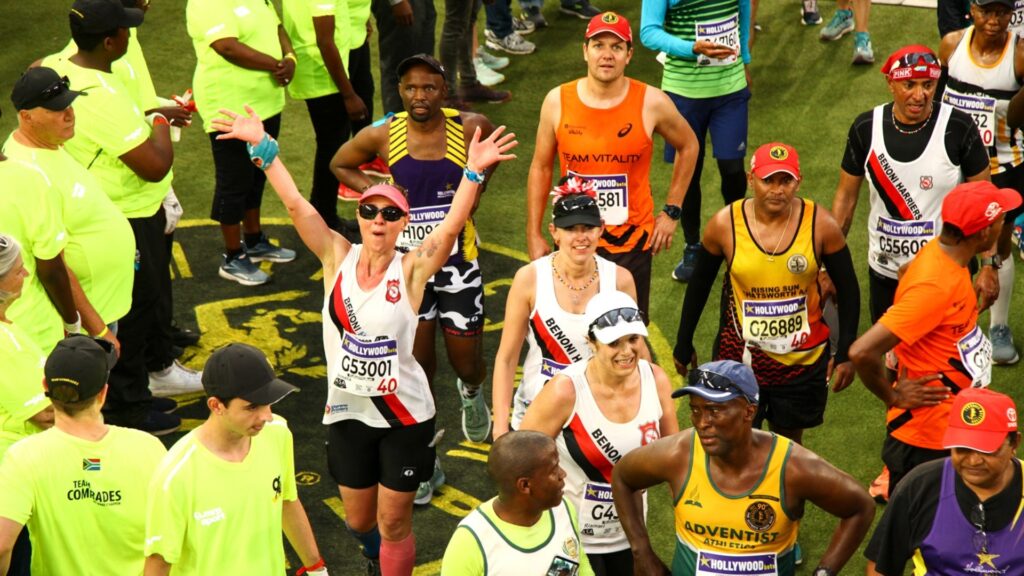
The 2027 Comrades Marathon is a down run from Pietermaritzburg to Durban on Sunday 13 June 2027, with a 12-hour limit, according to the official Comrades race information page. This guide covers how to train for it. For entries, the route and race-day logistics, see our Comrades Marathon resource guide.
In this guide:
- What a Comrades training plan has to prepare you for
- How long it takes to train for Comrades
- Choosing the right plan for your ability
- Qualifying and seeding
- How many kilometres a week you need
- Long runs, marathons and ultras in your build-up
- Training your quads for the down run
- Strength training
- Easy running and run-walk
- Recovery weeks and staying injury-free
- Fuelling and hydration
- The taper, race week and recovery
What a Comrades training plan has to prepare you for
A Comrades plan has one job: get you through roughly 90km of hilly road running inside your goal time without your legs failing in the final third. That means durability matters more than speed, and arriving healthy matters more than any single session.
The official race information puts the 2027 distance at approximately 90km, with the exact figure confirmed in the Final Race Instructions. Every official finisher has 12 hours from their gun start to cross the finish mat. Intermediate cut-offs along the route are also confirmed in the Final Race Instructions, so check those when they are published rather than relying on previous years.
Because 2027 is a down run, your plan needs to prepare your quads for long, repeated descents, not just the climbs out of Pietermaritzburg. That changes how you use hills in training, which is covered below.
Coach Parry is the official coach of the Comrades Marathon Association, and the principles in this guide are the same ones behind the Coach Parry Comrades Marathon Training Roadmap, which takes you through the full build-up matched to your goal.
How long does it take to train for Comrades?
Plan on most of a year if you are starting from a modest running base, and around five to six months of focused Comrades-specific training if you already run marathons comfortably. The official 2027 programmes start in July 2026, and the Finishers programme notes that the serious Comrades work runs from March until race day.
Think of the build-up in phases. Everything you do before January is the base your Comrades-specific training sits on. Coach Parry’s advice is to arrive in the new year fit and injury-free, and that it is better to start the year a little unfit and fresh than overtrained and tired.
| Phase | When | Focus |
|---|---|---|
| Base | July to December | Consistent easy running, strength, hills, first marathon |
| Qualify and build | January to February | Qualifying marathon if still needed, longer long runs |
| Peak | March to early May | Marathons and ultras as training runs, last long run |
| Taper | Final weeks to 13 June | Less volume, keep some quality, arrive fresh |
Starting from scratch is possible but leaves no margin for setbacks. If that is you, read our guide to going from couch to Comrades in one year before you commit.
Choosing the right Comrades plan for your ability
Choose the plan your current race times support, not the one for the medal you would like. Following a plan that is ahead of your ability is one of the most common reasons runners arrive at Comrades overtrained or injured.
The official Coach Parry programmes set clear entry points based on recent half marathon or marathon times. If you are a Comrades novice, use the row that matches what you can run now:
| Programme | Finish time | Novices who can run |
|---|---|---|
| Silver | Sub 7:30 | A sub-90 minute half, or close to 3:00 for a marathon |
| Bill Rowan | Sub 9:00 | A sub-1:45 half, or close to 3:40 for a marathon |
| Robert Mtshali | Sub 10:00 | A sub-1:55 half, or close to 4:00 for a marathon |
| Bronze | Sub 11:00 | A sub-2:10 half, or close to 4:30 for a marathon |
| Finishers | Sub 12:00 | Anyone starting out, including halves slower than 2:15 |
Previous Comrades finishers move up based on their past result. For example, the Bill Rowan programme is aimed at runners who have finished in under 10 hours, and the Bronze programme at those who have run under 10:30.
Be honest about borderline cases. The Bill Rowan programme itself warns that a marginal sub-3:30 marathon may not be enough for a sub-9 Comrades, especially if that marathon was on a fast course such as a sea-level, downhill or cool race.
If you want a plan that adapts to your current ability, with structure for the full build-up and support when life gets in the way, the Coach Parry Comrades Marathon Roadmap is built for exactly this race.
Qualifying and seeding for Comrades 2027
To run Comrades 2027 you need an official qualifying result submitted by 3 May 2027. The most common route is a marathon in 4:59:59 or faster.
The official qualifying standards include:
| Distance | Qualifying time |
|---|---|
| 42.2km | 4:59:59 |
| 50km | 6:09:59 |
| 56km | 6:59:59 |
| 64km | 8:14:59 |
| 80km | 10:34:59 |
Only official published results count. The race information page is explicit that Garmin, Strava and other personal tracking data are not accepted. You also need to complete a medical questionnaire through your online entry profile.
Squeaking in at 4:59 leaves little room on race day. The official Finishers programme targets a marathon under 4:50, which gives you a buffer, and suggests qualifying in early 2027 if that has not happened by the end of 2026.
Seeding is a separate question. The official race information says start group seedings for 2027 will be announced at the start of the year. Coach Parry’s long-standing advice is not to sacrifice training consistency chasing a better seeding batch, because the time gained at the start rarely outweighs the cost to your build-up.
Entries for 2027 have closed, and the official site says details on withdrawals and substitutions will be shared in due course. If you missed out, check comrades.com for redraws.
How many kilometres a week do you need for Comrades?
Less than most runners fear. Coach Parry’s guidance for the period from 1 January to race day ranges from about 850-1,000km in total for a sub-12 finish to roughly 2,000km for a silver medal.
| Goal | Total km from 1 Jan | Average km per week |
|---|---|---|
| Silver (sub 7:30) | About 2,000km | About 91km |
| Bill Rowan (sub 9:00) | 1,600-1,800km | 72-82km |
| Robert Mtshali (sub 10:00) | 1,200-1,400km | 55-64km |
| Bronze (sub 11:00) | 950-1,100km | 43-50km |
| Vic Clapham (sub 12:00) | 850-1,000km | 39-45km |
These weekly figures are averages across the whole build-up, so your peak weeks in April will be well above them. Treat them as a sense check, not a target to chase.
If you are short, resist the urge to add extra running days. More strength training is a safer way to add training stress than more kilometres. Our Comrades mileage guide goes into the detail behind these numbers.
What a typical Comrades training week looks like
A typical Comrades week has four runs, two strength sessions and at least one complete rest day. That is the shape of the official Finishers programme, and faster programmes add more quality sessions rather than simply more easy kilometres.
In the Finishers programme, a base-phase week is built around:
- Two strength days: on two of the three non-running days, with a full day between gym sessions
- Midweek easy runs: usually 35-50 minutes at easy pace, with walk breaks where needed
- A regular 5km time trial: every few weeks, to track progress and set training paces
- A weekend long run: prescribed by time, growing steadily through the build-up
The faster programmes keep the same skeleton but replace some easy running with structured sessions. The official Bill Rowan programme moves from hill repeats in July and August to intervals such as 6 x 1km with three minutes’ recovery in September and 8 x 600m with 90 seconds’ recovery in October.
The principle is the same at every level: each week should leave you ready for the next one. A week that leaves you exhausted is not a sign of good training. It is a warning that the plan, or the way you are running it, needs adjusting.
If you are juggling Comrades training with work and family, the session order can flex, but the balance of easy running, quality, strength and rest should stay the same.
Long runs, marathons and ultras in your build-up
Your long runs and races are where Comrades fitness is built, but more is not better. Most runners targeting anything slower than 10 hours need only one to two marathons and one to two ultras between January and race day.
How many races to run
Coach Parry’s guidance scales with ability:
- Vic Clapham and Bronze: one to two marathons and one to two ultras
- Robert Mtshali: two marathons and two ultras
- Bill Rowan: three marathons and two ultras
- Silver: three to four marathons and two to three ultras
Space them at least three weeks apart, and run them as training runs. After February especially, these races are preparation for Comrades, not chances to race for a personal best or a better seeding.
Time on feet, not just distance
The official Coach Parry programmes prescribe long runs by time, at a controlled long-run pace. The Finishers programme builds from runs of just over an hour in July towards three-hour-plus long runs later in the year. Time-based training lets faster runners progress naturally while protecting slower runners from spending excessive hours on their feet.
Your longest training run
For most runners the longest run is about 50-55km, done five to six weeks before race day. Novices should aim for six weeks out, more experienced runners five weeks. Beyond that point, extra distance adds more fatigue and injury risk than fitness.
If you race Two Oceans or another ultra in the build-up, allow at least three weeks before your next long run and keep it shorter, around 40-45km. Our guide on when to do your last long Comrades training run covers the timing in more detail.
Training your quads for the down run
On a down run, the descents do the damage. Running downhill loads your quads eccentrically, as the muscle lengthens under load, and unfamiliar eccentric exercise is well known to cause muscle damage and soreness.
The good news is that this kind of damage is trainable. Research reviewed in the Journal of Sports Science and Medicine describes the repeated bout effect: a previous bout of eccentric exercise reduces the damage from a later one, and in studies it protected muscles from damage after a downhill run. That protection can last for weeks to months, which is why downhill practice through your build-up pays off on race day.
How to build downhill resilience:
- Include rolling routes in your long runs and run the descents at controlled long-run effort, not flat out.
- Start with short, gentle descents and progress gradually, the same way you would build distance.
- Keep doing hill repeats uphill too. The official Bill Rowan programme, for example, progresses from 4 to 8 two-minute hill repeats, then to 8-10 one-minute repeats, in the base phase.
- Do your strength work. The official Finishers programme stresses that the eccentric loading on the downhills makes strength training critical.
For the route itself, see our Comrades down run route profile and description, and our guide to hill training for Comrades.
Strength training for Comrades
Strength training is a core part of Comrades preparation, not an optional extra. The official Finishers programme schedules it on two of your three non-running days each week, with at least one full day between gym sessions.
There is good evidence behind it. A systematic review by Blagrove and colleagues in Sports Medicine found good evidence that strength training improves running economy and time-trial performance in distance runners, although results were not consistent across every study.
For Comrades runners the payoff is durability: legs that tolerate the downhill pounding, and fewer niggles interrupting your build-up. Start early, so your body adapts to the extra load before your running volume rises. Our article on strength training for Comrades runners has more detail.
Easy running, pacing and run-walk
Most of your Comrades training should feel easy. Easy days exist so you recover fully, which is what allows you to absorb the long runs, hills and races that actually build Comrades fitness.
The official programmes give pace ranges for each type of run. As an example, the Finishers programme, set for a 4:50 marathon runner, lists:
| Run type | Pace per km | Pace per mile (approx.) |
|---|---|---|
| Easy | 7:00-7:36 | 11:16-12:14 |
| Long | 7:10-7:55 | 11:32-12:44 |
| Recovery | 7:36-8:13 | 12:14-13:13 |
Walking is part of the plan
Planned walk breaks help you hold your average pace for longer. In the official programmes, Finishers runners walk for one minute every 3-6km on long runs, and Bill Rowan runners walk for one minute every 6km. On hills, the programmes switch to run-walk intervals, such as one minute running and one minute walking, or two minutes running and one minute walking.
Practise your race-day walking strategy in training so it feels natural by June. Our guide to run-walk strategies for each Comrades medal breaks it down by goal time.
Pacing on race day
The biggest pacing mistake at Comrades is running the first third too fast because it feels easy. Use a pacing chart matched to your realistic goal and stay disciplined early. Our down run pacing strategy explains how to approach each third of the race.
Recovery weeks and staying injury-free
Injury is the biggest threat to finishing Comrades, so recovery is built into the plan rather than added when something hurts. The official programmes include a recovery week every four weeks, and they warn against adding extra training in those weeks.
Practical ways to protect your build-up:
- Take recovery weeks seriously, even when you feel good.
- Do not add extra runs or kilometres to “bank” fitness. The official programmes specifically caution against extra mileage.
- Keep easy days easy.
- Back off when fatigue does not lift after the first 10-15 minutes of a run, or carries over for several days.
See a doctor or physiotherapist if pain is persistent or getting worse, if you suspect a stress fracture, or if you experience chest pain or dizziness while running. A few days off early costs far less than weeks off later.
Fuelling and hydration for Comrades training
Race-day fuelling is a skill you build in training. Your long runs and training ultras are where you work out what you can eat and drink at Comrades effort without stomach problems.
Train your gut
The gut adapts to what you ask of it. A review by Asker Jeukendrup in Sports Medicine found the gastrointestinal system to be highly adaptable, with nutritional training likely to improve carbohydrate absorption and reduce the chance or severity of stomach problems during exercise. In practice, take in carbohydrate on every long run, using the products you plan to use on race day.
How much to take in
The International Society of Sports Nutrition position stand on ultramarathon nutrition recommends:
- Carbohydrate: 30-50g per hour
- Fluid: 450-750ml per hour, roughly 150-250ml every 20 minutes
- Sodium: possibly in higher concentrations than most commercial products provide
Do not overdrink
Drinking too much is more dangerous than mild dehydration. An international consensus statement on exercise-associated hyponatraemia, published in the British Journal of Sports Medicine, identifies sustained overdrinking as the single most important risk factor and recommends drinking to thirst as the safest individual strategy. Use the ranges above as a guide, and let thirst decide the detail.
The Comrades taper
The taper is where you cash in your training. You reduce volume so your body can recover and adapt, while keeping enough quality to stay sharp.
A meta-analysis published in Medicine and Science in Sports and Exercise found the most effective approach was a two-week taper in which training volume is reduced by 41-60%, without cutting intensity or frequency. For Comrades, the wind-down effectively starts earlier, because your last long run is five to six weeks out and your long runs shrink from there.
Two common taper mistakes:
- Testing your fitness with one more long run in the final weeks. The fitness is already there.
- Stopping all faster running. Short, controlled efforts keep your legs feeling sharp.
Our article on mastering the Comrades taper shows how to reduce your long runs week by week.
Race week and race day
Race week is about protecting what you have built: light running, plenty of sleep, familiar food and a race plan you have rehearsed. Nothing new on race day.
Read the Final Race Instructions carefully when they are released, as they confirm the exact distance and cut-off points. For practical help, see our Comrades race week dos and don’ts and our race-day tips for Comrades novices.
Recovering after Comrades
Recovery after Comrades takes longer than most runners expect. Coach Parry’s guidance is two weeks with no running, light cross-training such as swimming or cycling in week three, and short, easy 20-30 minute jogs in week four before structured training resumes.
Sleep, good food and patience matter more than any recovery gadget. Our guide to post-Comrades recovery covers the full plan.
Comrades training FAQs
How many months do you need to train for Comrades?
If you already run marathons comfortably, around five to six months of Comrades-specific training from January is typical, built on a solid base from the second half of the previous year. Newer runners should allow closer to a year. The official 2027 programmes begin in July 2026.
What marathon time do you need to run Comrades?
The qualifying standard for 2027 is a marathon in 4:59:59 or faster, submitted by 3 May 2027. To finish inside 12 hours with some margin, the official Finishers programme targets a marathon under 4:50.
Can a beginner run Comrades?
Yes, provided you give yourself enough time, qualify through an official race and follow a plan that matches your current ability. The Finishers programme exists for exactly this group, with walk breaks and time-based long runs designed to get first-timers to the finish healthy.
Get the right Comrades plan for you
Comrades rewards runners who are consistent, patient and honest about their ability. The plan that gets you a medal is the one that keeps you healthy enough to train for months and gets you to Pietermaritzburg fresh.
Coach Parry has coached Comrades runners from first-time finishers to the front of the field, and the Comrades Marathon Roadmap gives you a structured build-up matched to your goal, from base training through to race day.


Comments are closed.