
What will stop you on 13 June 2027: the climbs, or the descents? The 100th Comrades Marathon is a down run from Pietermaritzburg to Durban, and on a down run it is the descents late in the race that do the damage. That makes now, less than eight months out, the right time to start getting your quads ready.
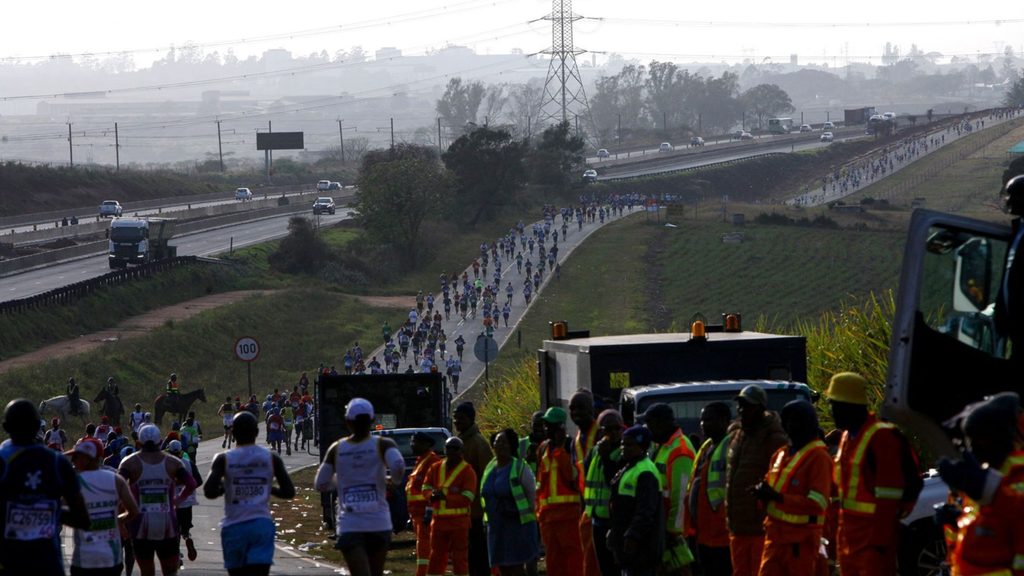
Comrades down run training is normal Comrades training with one extra job: preparing your quads for hours of downhill running. You do that with regular, gradual downhill running in your long runs, hill repeats, and strength training from now until May. Start early, build slowly and keep it going all the way through your build-up, because the protection your legs gain from downhill running fades if you stop.
This post goes deeper on the down run than my complete guide to Comrades Marathon training, which covers the whole year, from qualifying to your taper.
In this guide
Why is the Comrades down run so hard on your quads?
Running downhill makes your quads work eccentrically: they lengthen under load as they operate as shock absorbers every step. That kind of work causes far more muscle damage than running on the flat, and it is the reason down run legs fall apart late in the race.
A narrative review of downhill running research published in Sports Medicine (Bontemps and colleagues, 2020) sums up how big the effect is:
- Immediately after downhill running, studies report drops in knee extensor (quadriceps) strength of between 14% and 55%.
- That strength loss generally lasts up to four to five days before full recovery.
- Muscle soreness typically peaks 24 to 48 hours afterwards.
Now picture that damage building up over a full day on the road. The 2027 race starts at Pietermaritzburg City Hall and finishes at the Kings Park Rugby Precinct in Durban, and the Comrades Marathon Association puts the distance at approximately 91km, with the official figure to come once the course is measured.
Here’s the catch. The first 30km out of Pietermaritzburg have very little downhill in them, so the course doesn’t feel like a down run when you are fresh. The descents arrive when you are already tired, and the drop off Fields Hill into Pinetown comes deep into the race. This is why I say in my programmes that the eccentric load (pounding) on your legs is extremely high on a down run.
When should Comrades down run training start?
Start now. Strength work and gentle downhill running both take months to pay off, and my 2027 programmes, which began in July 2026, ask you to start your strength programme early so your legs are used to the added work long before your peak weeks.
There’s also a good reason not to cram it all into April. Your body adapts to downhill running through what researchers call the repeated bout effect: one bout of downhill running reduces the damage from the next one. The same Sports Medicine review notes that this protection is limited in time. In one study it had disappeared after nine weeks without eccentric work between bouts.
So the goal is regular downhill exposure through the whole build-up, not one big session. A little every week from now until May beats a lot in one month.
| Phase | When | Down run focus |
|---|---|---|
| Base | Now to December | Start strength work, hill repeats, easy rolling routes |
| Foundation | January to February | Two to three strength sessions a week, longer rolling long runs |
| Comrades training | March to early May | Two strength sessions a week, regular descents in long runs and races. |
| Taper | Second week of May to race day | One strength session a week, no new or damaging downhill work |
How to train your quads for the Comrades down run
You train your quads for the down run with three tools: downhill running in your long runs, uphill hill repeats, and strength training. You need all three. The descents teach your legs to cope with the pounding, the hills build strength and fitness, and the gym work makes the muscles more resilient.
Run descents in your long runs
Choose rolling routes for your long runs and run the descents at controlled long-run effort, not flat out. Start with short, gentle descents and progress gradually, exactly as you build distance. The review is clear that downhill sessions need a principle of progressivity, and that early on you may need longer recovery after them.
You will feel it the first few times. Sore quads two days after a hilly long run is normal in the beginning. Sore quads that never dissipate, or pain in a joint or tendon, means you have done too much too soon. Back off, and see a physiotherapist if the pain is persistent or getting worse.
Keep doing your hill repeats
Uphill repeats are still important on a down run, because there is plenty of climbing on the way to Durban, Inchanga included. Plus the easy recovery allows for gentle eccentric work. In my Bronze medal programme, the hill sessions build from 4 x 2 minutes in September to 8 x 2 minutes by early January, with 10 minutes of easy running before and after.
Strength training for the Comrades down run
Strength training is important for both directions, but on the down run I see it as non-negotiable. Stronger legs are better able to handle the braking forces of the descents, and strength training improves running economy by 2-8%, so you use less energy at the same pace.
The research, therefore, supports the eccentric work too. The Sports Medicine review notes that eccentric-biased training is well known to improve maximal strength, and in one study five weeks of downhill running training improved knee extensor strength by about 9-24%.
How often to do it through the year:
- January and February: two to three sessions a week
- March and April: two sessions a week
- May: one session a week, to hold on to your strength gains
Strong legs are what get you up the hills and still working on the long descents. My free Comrades strength training plan is one session a week, done at home with no expensive gym equipment, and every exercise comes with the reps and a short demo video. It’s a simple way to start now and build from there.
Comrades down run training plan: a sample week
A down run training week has the same shape as any Comrades week, with downhill work added during the sessions you already do. Here is how I structure it:
| Day | Session | Down run focus |
|---|---|---|
| Monday | Strength | Easier strength session |
| Tuesday | Higher-intensity session | Hill repeats in your hill phases |
| Wednesday | Strength | Main strength session |
| Thursday | Easy run plus strength | Easy effort on any route, plus a possible third strength session if you are coping with the overall load |
| Friday | Rest | Full rest |
| Saturday | Long run | Rolling route, descents at long-run effort |
| Sunday | Easy run | Easy effort, walk as needed |
Use as many of the strength slots as the month calls for (see the list above). The downhill work goes inside your long run and your hill session rather than being added as extra sessions. As I warn in my programmes, don’t be tempted to do more, because it will only compromise you later in the build-up.
Recovery weeks still apply. My programmes include a recovery week every four weeks, and that is when your legs absorb the downhill work you have done. You get fitter in the recovery between sessions, not during them.
If you would rather not piece this together yourself, my Comrades Marathon Roadmap sets out every week for you, from base training to race day, with the strength work, long runs and recovery weeks already in place.
How to run downhill on the Comrades down run
Run the descents with a shorter stride, at the effort your pacing chart asks for. Studies summarised in the Sports Medicine review found that shortening step length by about 10% reduced the energy the knee and hip had to absorb when running downhill.
Practise this on every descent in training, so it is automatic by June. A few pointers:
- Shorten your stride on every descent.
- Run descents at the effort your pacing chart asks for, not faster. There is no need to charge down the hills.
- Walk on purpose. In my programmes, long runs include a one-minute walk every 3-6km, and you run/walk the hills with 1-2 minutes of running and 1 minute of walking.
The biggest down run mistake is racing the descents to bank time. Pushing hard down Fields Hill, either to catch up or to get ahead, can do an extraordinary amount of damage, and you pay for it later in the race. For section-by-section help on race day, read my guide to pacing the perfect Comrades race.
Comrades down run FAQs
Is the Comrades down run harder than the up run?
It’s a different kind of hard. It is the same stretch of road, but the up run tests you on the climbs, while the down run tests how well your quads cope with hours of eccentric pounding. If your legs aren’t prepared for that, the down run can be every bit as hard as the up run.
How long is the 2027 Comrades down run?
The Comrades Marathon Association says approximately 91km, from Pietermaritzburg City Hall to the Kings Park Rugby Precinct in Durban. The official distance will be confirmed once the course is measured, so check the Final Race Instructions when they are released.
When should I stop strength training before Comrades?
If you have trained consistently, keep your strength work going until about 7-10 days before the race. If you only add strength training later in the plan, especially for a down run, stop about 10 days out. I explain why in my post on when to stop Comrades strength training.
Get your legs ready for Durban
The 2027 down run will reward the runners who prepared their legs, not just their lungs. Make Comrades down run training part of every week from now on: a little downhill in your long runs, your hill repeats and your strength sessions, all built up gradually so you arrive in June strong rather than sore.
If you want this built into a full plan matched to your goal, my Comrades Marathon Roadmap takes you from base training to race day, with the strength work and long runs already in place. See you at Kings Park.


Comments are closed.