
Here is how to start running: run three days a week, mix running with walking, go slowly enough that you can hold a conversation, and add a little more running each week. Have at least one full rest day a week, do one short strength session, and wear comfortable shoes that fit. Give it about 12 weeks, and your first goal is to run 30 minutes without stopping, or to finish a 5km.
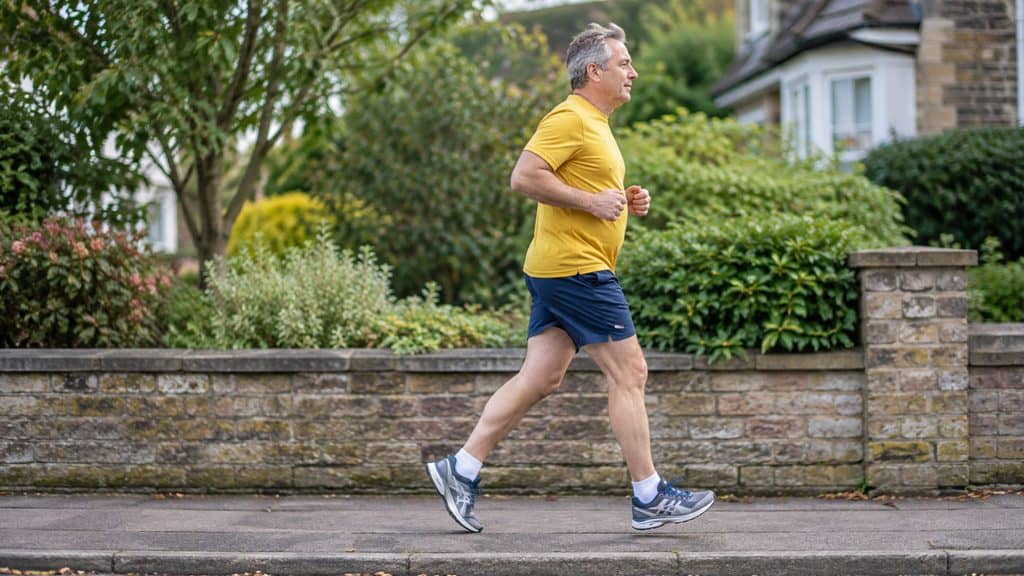
That’s the whole recipe. It isn’t complicated, which is exactly why so many new runners ignore it. They head out on day one, run as hard as they can until their lungs burn, decide they “aren’t built for running” and give up within a fortnight. Or worse, they push through, get shin splints in week three and give up anyway.
Running doesn’t have to feel like that. If it does, you’re almost certainly going too fast or doing too much too soon. Both are easy to fix, and this guide shows you how.
In this guide:
- Why starting running is worth it
- Before your first run: health checks and kit
- How often a beginner should run
- How fast to run (slower than you think)
- The run-walk method, and a first-month plan
- How to breathe while running
- When running starts to get easier
- Strength training and rest days
- Avoiding the injuries that stop new runners
- Starting running when you’re overweight, older or coming back after a break
- Your first goal: parkrun, 5km and beyond
- The beginner mistakes I see most often
Why start running?
Because even a small amount of running makes a big difference to your health. You don’t need to run far or fast to get the benefit, which is great news if you’re starting from the couch.
A study of 55,137 adults followed over 15 years, published in the Journal of the American College of Cardiology, found that runners had a 30% lower risk of death from any cause and a 45% lower risk of dying from heart disease or stroke than non-runners. On average, runners lived about three years longer. The striking part is that the benefit showed up even in people who ran less than 51 minutes a week, or slower than 6 miles per hour, according to the American College of Cardiology’s summary of the study.
The same study found that the people who kept running for around six years got the most benefit. In other words, the real prize isn’t getting through the first month. It’s still running a few years from now.
Running also ticks most of the boxes in the World Health Organization’s guidelines. The WHO recommends adults get at least 150-300 minutes of moderate aerobic activity, or 75-150 minutes of vigorous activity, every week, plus muscle-strengthening work on at least two days. Three runs and a couple of short strength sessions a week gets you a long way there.
Before your first run: health checks and kit
For most people, starting to run needs nothing more than a pair of comfortable shoes and the patience to start slowly. But a few people should speak to a doctor first.
Should you see a doctor before you start running?
If you have a known heart condition, new chest pain you haven’t discussed with your doctor, diabetes you’re not sure how to manage around exercise, or you’ve been very inactive for a long time, get checked first. The UK’s Moving Medicine guidance on staying safe while exercising also advises getting medical help straight away if you feel dizzy or faint, or have chest pain that gets worse or doesn’t settle within a couple of minutes of stopping. Never “run through” symptoms like these.
Running shoes
Your shoes are the one piece of kit worth spending a bit of time on. You don’t need the most expensive pair in the shop. You need a pair that feels comfortable from the moment you run in it.
My advice is to start with a running assessment from a physiotherapist, biokineticist or podiatrist with experience in running, so you know which type of shoe suits you. Then try several pairs in that category, run a few hundred metres in each and choose the most comfortable, regardless of brand or colour. Don’t buy them tight: your feet swell as you run, so I usually suggest going up a size from your everyday shoes.
Everything else
Beyond shoes, keep it simple:
- Clothing that doesn’t hold sweat. Technical fabrics are more comfortable than cotton once you warm up.
- A good sports bra. For women, a properly fitted high-impact bra makes a huge difference to comfort.
- Sun protection. A cap and sunscreen, especially if you run in the middle of the day.
- Something to time yourself. A phone or a basic watch is plenty. You don’t need a GPS watch to start, and a heart rate monitor can wait.
How often should a beginner run?
Three days a week, with a rest day between runs. That’s enough to make steady progress and gives your body time to adapt between sessions.
Remember that you don’t get fitter during a run. You get fitter in the recovery afterwards, when your body repairs and adapts to the work you’ve done. A beginner who runs every day never gives that process a chance, and that’s when things start to hurt.
A simple week looks like this: run on Tuesday, Thursday and Saturday, with strength sessions on Monday, Wednesday and Thursday and Friday as a rest day. If you want to do more, add cross-training such as cycling or swimming rather than a fourth run. Once running three times a week feels comfortable, you can add a fourth day: an easy run on Sunday, the day after your longer run.
| Day | What to do |
|---|---|
| Monday | Strength session |
| Tuesday | Run-walk, 20-30 minutes |
| Wednesday | Strength session |
| Thursday | Run-walk, 20-30 minutes, plus a strength session |
| Friday | Rest |
| Saturday | Longer run-walk, 30 minutes and increasing |
| Sunday | Rest, or an easy walk, cycle or swim (this becomes an easy run when you add a fourth day) |
How fast should a beginner run?
Slowly enough to talk in full sentences. If you can’t, you’re going too fast, and that’s true whether your pace is 6 minutes per kilometre or 10.
The easiest way to judge this is the talk test. The US Centers for Disease Control and Prevention describes moderate effort as being able to talk, but not sing, while vigorous effort means you can’t say more than a few words without pausing for breath. As a beginner, almost all of your running should sit at the moderate, chatty end.
This is the part most new runners get wrong. They assume running is supposed to feel hard, so they run every run at a pace that leaves them gasping. It isn’t. When you run easy, run REALLY easy. Easy running builds the aerobic engine that everything else depends on, and it’s the reason I’m such a fan of slowing down.
Forget about pace for your first few months. Run by feel and by time, not by distance or kilometres per hour. Speed comes later, on its own, from consistency.
The run-walk method: how to go from zero to 30 minutes
The run-walk method means alternating short periods of running with periods of walking, then gradually shifting the balance towards running. It’s the safest, most reliable way to start, and there’s no shame in it at all.
Walking breaks let your heart, lungs, muscles, tendons and bones adapt a little at a time. Your heart and lungs tend to adapt faster than your tendons and bones. Walk breaks stop the fast-improving parts of you from dragging the slow-improving parts into an injury.
A first-month run-walk plan
On my team, we like brand-new runners to start with 4 minutes of walking and 1 minute of running, repeated three or four times, for a total of 15-20 minutes in the first week. The 1 minute of running is NOT a sprint. Jog it gently.
Each week you run a little more and walk a little less. In week two, for example, it becomes 3 minutes of walking and 2 minutes of running. Two of your three weekly sessions stay at 20-30 minutes, and the third becomes your longer session, starting at around 30 minutes and adding about 5 minutes a week.
| Stage | Weekday sessions | Longer weekend session |
|---|---|---|
| Week 1 | Walk 4 min / run 1 min, three or four times (15-20 min) | About 30 minutes |
| Week 2 | Walk 3 min / run 2 min, building towards 20-30 min | About 35 minutes |
| Following weeks | Keep shortening the walks and lengthening the runs | Add about 5 minutes a week |
| Every 3rd or 4th week | A lighter week: hold or ease back | Shorter than the week before |
That lighter week is deliberate. I like new runners to build in blocks and take a lighter week every third or fourth week, so the body can catch up and absorb the training. You don’t stop running in that week; you just do a bit less of it.
If a week feels too hard, repeat it. There’s no prize for rushing. For comparison, the NHS’s popular Couch to 5K plan uses three run-walk sessions a week for nine weeks, starting with 1 minute of running and 90 seconds of walking, with the goal of running for 30 minutes by the end. Different plans use slightly different ratios, but they all share the same principle: start small and build gradually.
Warm up and cool down
Start every session with about five minutes of brisk walking, as the NHS plan does, and finish with a few minutes of walking too. It’s an easy habit that makes the first running interval feel far less of a shock.
Once you’re comfortable with your run-walk sessions, drills are one of the quickest ways to make running feel easier. Get my free running drills sequence and do it at home before your runs.
How to breathe while running
Breathe deeply and rhythmically through whatever feels natural, nose or mouth. If you’re panting with short, shallow breaths, slow down or take a walk break before it gets to that point.
Feeling out of breath is the number one reason new runners think they “can’t run”. In almost every case it’s a pacing error, not a lung issue. Shallow, rapid breathing doesn’t clear carbon dioxide or bring in oxygen efficiently, so you tire quickly and are more likely to get a stitch.
Slow down until you can breathe deeply and rhythmically. As your fitness improves, the same pace will feel easier, and your breathing will settle without you having to think about it.
Why running feels so hard at first, and when it gets easier
Running feels hard at first because your body hasn’t adapted to it yet, and because most beginners run too fast. It gets easier with consistency: slow down, stick to three runs a week, and the same effort gradually starts to feel more comfortable.
The NHS Couch to 5K plan is a good benchmark here. It takes someone from running just 1 minute at a time to 30 minutes continuously in nine weeks. That’s what’s possible when you stick to a sensible plan.
Expect some ups and downs along the way. Some runs will feel great; others will feel like you’re running through treacle, even though nothing has changed. That’s normal. Judge your progress over weeks, not individual runs.
Strength training and rest days for new runners
Add one short strength session a week from the start, and keep at least one full rest day. Strength work is what keeps you on the road, and rest is when your body actually gets fitter.
Why strength training is crucial
Strength training is one of the best ways to reduce your injury risk. A meta-analysis in the British Journal of Sports Medicine found that strength training reduced sports injuries to less than a third, making it the most effective prevention method studied, while stretching showed no protective effect (Lauersen and colleagues, 2014). That research covered a range of sports, not just running, but the message for runners is clear.
You don’t need a gym. Start with 20-30 minutes of bodyweight exercises once a week, focusing on your glutes, hamstrings, quads, calves, the small stabilising muscles of your lower legs and your core. Squats, lunges, glute bridges, calf raises and planks are a perfect place to start. Over time, work towards two sessions a week, in line with the WHO’s guidance.
Rest and cross-training
Have at least one full rest day every week. On your other non-running days, cycling, swimming or brisk walking build your fitness without the pounding of running. For new runners, this is a great way to do more without overloading your legs.
Avoiding the injuries that stop new runners
New runners get injured more often than experienced ones, and the main cause is doing too much too soon. Build up gradually, run easy, do your strength work and stop if something hurts.
The numbers make the point. A systematic review in Sports Medicine found that novice runners had about 17.8 injuries per 1,000 hours of running, compared with 7.7 for recreational runners, more than double the rate (Videbæk and colleagues, 2015). Your body simply isn’t used to the impact yet.
How fast should you increase your running?
Gradually, and by small steps. A study of 874 novice runners in the Journal of Orthopaedic and Sports Physical Therapy suggested that beginners who increased their weekly distance by more than 30% over two weeks may be more prone to injuries such as runner’s knee, ITB syndrome and shin splints (Nielsen and colleagues, 2014). The researchers described the study as exploratory, so treat it as a guide rather than a hard rule. My approach is simpler: increase your running a little at a time, take a lighter week every third or fourth week, and repeat a week whenever you need to.
The most common beginner injuries
- Shin splints: pain along the inside of the shin bone, very often from building up too quickly.
- Knee pain: often caused by running too fast, too soon, or in the wrong shoes.
- Calf and Achilles soreness: common when your lower legs are adapting to running, and another reason to include calf raises in your strength work.
Soreness or injury?
Some general muscle stiffness a day or two after a run is normal when you’re new. Sharp pain, pain that makes you limp, pain that gets worse as you run, swelling, or pain in one specific spot on a bone is not. If you have any of those, stop running and see a physiotherapist or doctor, especially if you suspect a stress fracture. My guide to running injuries covers more of the basics.
Starting running in special situations
The same principles apply to everyone: start with walking and running, build slowly, and run easy. But a few groups of beginners benefit from some extra care.
Starting running when you’re overweight or out of shape
You can absolutely start running if you’re carrying extra weight, but walk before you run. Do more walking than running in your first weeks, because walking builds up the muscles, tendons and ligaments you need for running with less load on your joints. Cross-training such as cycling or swimming lets you work harder without the impact. If you have health concerns linked to your weight, speak to your doctor first.
If weight loss is your goal, running helps, but it isn’t a guarantee on its own. What you eat matters at least as much.
Starting running at 50, 60 or beyond
It’s never too late to start. You may need more recovery between runs and strength training becomes even more important, but the approach in this guide works at any age. Read my guide on how to start running in your 50s, 60s, 70s and beyond, and once you’re up and running, my complete guide to running over 50 covers how to keep improving.
Starting running again after a break
If you used to run, your fitness may come back faster than it would for a complete beginner, but your tendons and bones need time to readjust. Start with run-walk, even if it feels too easy, and build up over several weeks rather than picking up where you left off. If you stopped because of an injury, get the all-clear from your physiotherapist first.
Starting running on a treadmill
Treadmill running counts. It’s a great option when it’s dark, wet or unsafe outside, and the belt makes it easy to control your pace. Use the same run-walk structure and the same talk test. Just make sure some of your running happens outdoors as you progress, because road running feels different and your body needs to adapt to it too.
Your first goal: parkrun, 5km and beyond
The best first goal for a new runner is 5km, whether that’s running it continuously or finishing your first parkrun with walk breaks. It’s long enough to feel like a real achievement and short enough to reach in a few months.
parkrun is perfect for this. It organises free, weekly, timed 5km events around the world, open to every ability, first-timers included. Having a date to aim for gives your training a purpose, and the atmosphere is about as friendly as running gets.
Once you’ve done a few parkruns, the natural next step is 10km. The jump is smaller than it looks: add 2-3 minutes a week to your longest run, gradually reduce your walk breaks and consider moving to three or four runs a week. My 10km Training Roadmap takes you from 5km to 10km.
If you’d rather follow a structured plan from day one than piece one together yourself, my 5km Training Roadmap is a 12-week plan with a version for every goal, from just finishing in one piece to chasing a fast time. Every run comes with pacing guidelines, recovery is built in, and the strength training needs no gym.
Once you’ve done your first parkrun, the next goal is usually a faster one. My free parkrun running drills come with step-by-step descriptions and short videos, and you can do them at home once a week.
The beginner mistakes I see most often
Most new runners who give up do so for the same handful of reasons, and every one of them is avoidable.
- Running too fast. If you can’t talk, slow down. Every new runner thinks they’re the exception. They aren’t.
- Doing too much too soon. Feeling good in week two doesn’t mean your shins are ready for double the running. Stick to the plan.
- Skipping walk breaks out of pride. Walking is a training tool, not a failure.
- Ignoring pain. A niggle you rest for three days is better than an injury that stops you for six weeks.
- Skipping strength training. It’s the least exciting part of the week and one of the most important.
- Running in the wrong shoes. Old gym shoes or fashion trainers aren’t designed for running.
- Measuring every run. Progress shows over weeks and months, not from one run to the next.
How to start running: FAQs
How long should a beginner run for?
Start with sessions of 15-20 minutes, including walking, in your first week, and build towards 20-30 minutes for your regular runs and 30-60 minutes for your longer weekend session. Time matters more than distance at this stage.
Is it OK to walk during a run?
Yes. Walk breaks are the foundation of a good beginner plan. They let you run for longer overall, keep your breathing under control and reduce your injury risk. Plenty of experienced runners still use them in long races.
How long does it take to go from couch to 5km?
Expect around 9-12 weeks. The NHS Couch to 5K plan takes nine weeks to reach 30 minutes of continuous running, and my 5km Training Roadmap is a 12-week plan. If you need to repeat weeks, that’s fine. Getting there injury-free matters more than getting there fast.
Should I run every day as a beginner?
No. Three days a week with rest days in between is the right starting point. Your body adapts in the recovery between runs, so more running isn’t always better, especially in your first few months.
Start running the right way
Learning how to start running comes down to patience. Run three times a week, walk as much as you need to, keep it slow enough to talk and build up a little at a time. Do that for 12 weeks and you won’t just be able to run 5km. You’ll be a runner, with the habits that keep you running for years.
If you want a plan that tells you exactly what to do every day, with pacing for every run and strength training built in, start with my 5km Training Roadmap. Lace up, start slower than you think you should and enjoy it. The first run is the hardest one you’ll ever do.


Comments are closed.