
Every running training plan looks good on paper. The one that works is the one that fits you: your current fitness, the time you really have each week, your age and your goal race. A good running training plan builds you up gradually, keeps most of your running easy, includes strength training and recovery weeks, and tapers you into race day fresh. Pick a plan that matches the runner you are today, not the one you hope to be in three months, and you have already avoided the mistake that derails most training blocks.
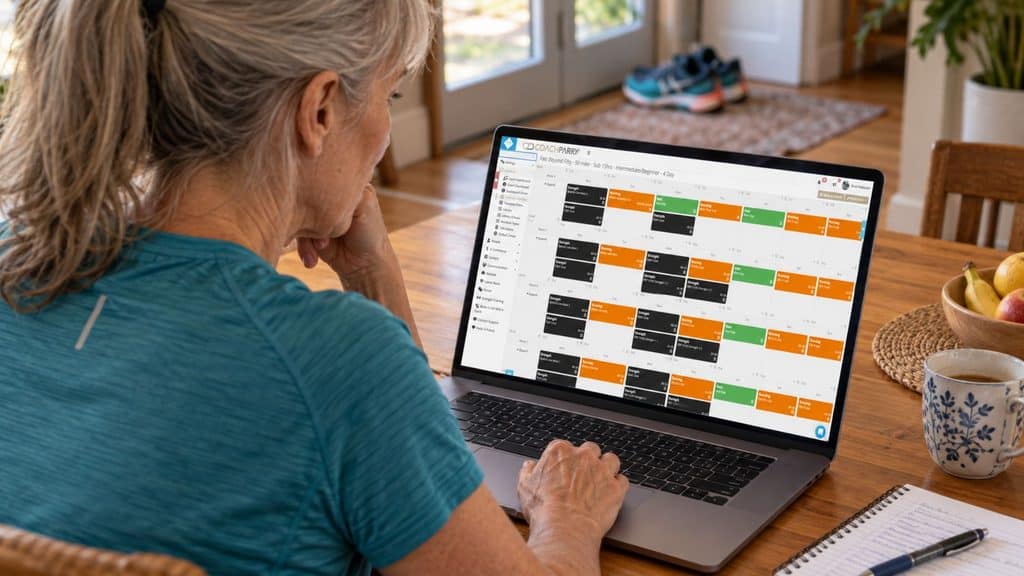
The choice is wider than ever. Free PDFs, adaptive apps on your watch, structured programmes and one-on-one coaching all promise to get you to the finish line. This guide helps you work out which one is right for you, and what a good plan should look like whichever route you take.
In this guide:
- What a running training plan is, and what it should include
- What a training week looks like
- How to choose a plan for your goal and current fitness
- How long your plan should be for each distance
- Plans for beginners and for runners over 50
- Free vs paid plans, and training apps vs a coach
- What coaching costs
- What to look for in a marathon or Comrades plan
- How to adjust your plan when life gets in the way, or when you miss a week
What is a running training plan?
A running training plan is a week-by-week schedule that takes you from your current fitness to a specific goal, such as finishing your first 5km or running a marathon personal best. It tells you which days to run, how far or how long, how fast, and when to rest, recover and taper.
That sounds simple, but the order of the sessions matters as much as the sessions themselves. You don’t get fitter during a hard run. You get fitter in the recovery afterwards, when your body adapts to the work you have just asked of it. A good plan is really a schedule of stress and recovery, arranged so that each week builds on the last without hurting you.
What every good running plan includes
Whatever the distance, a plan worth following has these building blocks:
- Easy runs: the bulk of your running, done at a conversational pace.
- A long run: once a week, steadily increasing over the block.
- One higher-intensity session: intervals, a tempo run or hills, depending on your goal.
- Strength training: two to three short sessions a week.
- Rest and recovery weeks: at least one full rest day a week, and a lighter week every three to four weeks.
- Pace or effort guidance: so you know how hard each run should feel.
- A taper: a planned reduction in training before race day.
If a plan is missing two or three of these, it isn’t a plan. It’s a list of runs.
What does a running training plan look like each week?
Most of my plans are built on four days of running a week: three runs of mixed intensity and duration, plus a long run. Strength training slots in on separate days, and there is always at least one full rest day.
Here is the weekly structure I use:
| Day | Session |
|---|---|
| Monday | Strength |
| Tuesday | Higher-intensity session |
| Wednesday | Strength |
| Thursday | Easy run plus strength |
| Friday | Rest |
| Saturday | Long run |
| Sunday | Easy run |
If you’re a beginner on three runs a week, keep the same strength days and run on Tuesday, Thursday and Saturday. The Sunday easy run is the fourth day you add once three runs a week feel comfortable.
Why easy runs are more important than you realise
Easy runs build your aerobic engine and give your muscles, tendons and ligaments time to adapt. Easy means you could hold a conversation the whole way. Run them too fast and you’ll be tired for the big sessions, which is exactly when you need to be fresh. One of the most common reasons runners stop improving is that every run drifts into the same moderately hard effort.
Not sure how fast your easy runs, tempo runs or intervals should be? Use my free training zone calculator to find your ideal training paces, so every session does the job it’s meant to.
How the weeks fit together
The weeks shouldn’t all look the same. I break a 12-week plan into three four-week cycles: three weeks of loading, then a recovery week with less volume so your body can absorb the work. A recovery week isn’t a week off. You still run, just less, and you don’t add extra training to “make the most” of feeling fresh.
In my marathon plans, a 5km time trial every four weeks tells you whether the plan still fits. If you’re ahead of or behind where the plan expects, adjust your paces rather than forcing the original target.
How to choose a training plan for your running goal
Choose the plan your current race times support, not the one for the time you’d love to run. A plan that is ahead of your fitness is one of the quickest ways to get injured or arrive at the start line exhausted.
Before you pick a plan, answer these four questions honestly:
- What can you run right now? A recent 5km, 10km or half marathon time is the best guide to your fitness. A goal time is not.
- How many days a week can you really train? Count the days you can run every week, including the busy ones, not the days you could run in a perfect week.
- How long until race day? If the gap is shorter than the plan, choose an easier goal or a later race.
- What’s your injury history? If you break down every time your weekly kilometres go up, you need a plan with more gradual progression and more strength work, not more running.
Use your current times, not your dream time
For the marathon, your half marathon time is the clearest signal. If you want to break four hours, I’d want to see you run a half marathon in under 1:55 first. If your half is slower than that, do a half marathon training block before the marathon block. Yes, that adds 12 weeks. It also gives you a far better chance of actually running the time.
My complete guide to marathon training has the full table of half marathon times I use as entry points for each marathon goal, from finishing to sub-3 hours.
Don’t copy someone else’s plan
Your club mate’s plan was built for your club mate. No two runners respond to the same training in the same way, and the weekly kilometres that work for a sub-3-hour runner can break a first-timer. If you’re unsure between two plans, choose the slightly easier one. You’ll arrive at the start line fresher, and fresh beats fit-but-tired every time.
How long should a training plan be for a 5km, half marathon or marathon?
Twelve weeks of race-specific training is enough for most distances, as long as you start that block with a base already in place. The longer the race, the more base you need before those 12 weeks begin.
| Goal | Race-specific block | What you need before you start |
|---|---|---|
| First 5km | About 12 weeks | Nothing: start with run-walk |
| Half marathon | About 12 weeks | Able to run 10km comfortably |
| Marathon | 12 weeks | 8-12 weeks of consistent running, ideally a recent half marathon |
| Marathon from scratch | About 48 weeks | Four 12-week stages: 5km, 10km, half, then marathon |
| Comrades | March to early May, then a taper to race day | A base from the second half of the previous year, a qualifying marathon and a January-February foundation |
There’s nothing magic about a 16 or 20-week plan. What matters is that the final 12 weeks are spent on race-specific training, built on fitness you already have. Not even the best athletes can sustain much more than about 12 weeks of peak training, so starting the hard part too early just leaves you mentally and physically flat by race day.
If your race is closer than that, you have two options: pick a less ambitious goal, or pick a later race. Cramming a 12-week plan into eight weeks is how runners end up injured in week six.
Running plans for beginners: what to look for
A beginner’s plan should start with three days a week, use run-walk intervals, and build slowly enough that most weeks feel achievable. If the first week of a plan has you running 30 minutes without stopping, it isn’t a beginner’s plan.
The best beginner plans share a few features:
- A rest day between runs, so your body can adapt.
- Run-walk sessions that gradually shorten the walking and lengthen the running.
- One short strength session a week to start with.
- A lighter week every third or fourth week.
- Permission to repeat a week when you need to. There’s no prize for rushing.
Your first goal is to run 30 minutes without stopping, or to finish a 5km. My guide on how to start running takes you through the first 12 weeks step by step, and my 5km Training Roadmap lays out every session for you with the pace for each run.
Choosing a training plan for runners over 50
After 50, the right plan has fewer running days, more recovery and more strength training than the plan you followed at 30. Most runners over 50 get better results from three or four days of running a week than from six or seven.
That isn’t about doing less for the sake of it. Recovery takes longer as you get older, and the extra recovery time is what lets your body actually get fitter. A plan built for a 30-year-old can leave a 55-year-old permanently tired, picking up niggles and wondering why they’re getting slower. Look for these in a plan for older runners:
- Three or four running days a week, not five or six.
- Strength training on at least two days a week.
- A recovery week every three to four weeks.
- Easy runs that are genuinely easy, with walk breaks where needed.
- Goals measured against your age, not your younger self.
If you’re over 50 and feel like you’re slowing down or picking up more niggles, strength work is the fix most runners skip. Grab my free strength plan for runners over 50: done-for-you workouts with videos, reps and coaching tips.
My complete guide to running over 50 covers the full approach, and my Faster Beyond 50 programme gives you training plans built around the way your body recovers now. For women navigating perimenopause and menopause, my Running Through Menopause programme is designed for exactly that stage.
Free vs paid running plans: what’s the difference?
A free plan gives you a schedule. A paid plan should give you a schedule that fits you, explains how hard each session should be, and includes the strength, recovery and taper that free plans often leave out. If a paid plan doesn’t do more than that, it isn’t worth paying for.
| What you get | Typical free plan | Good paid plan |
|---|---|---|
| Sessions | Distances or times for each day | Daily sessions with a pace or effort for each run |
| Matched to your fitness | One plan for everyone, or a few levels | Separate versions for different goals and abilities |
| Strength training | Often missing | Built in, with instructions |
| Recovery weeks and taper | Sometimes | Planned in |
| Support when things go wrong | None | Varies: from none to a coach |
A free plan can work well if you’re an experienced runner who knows how to adapt a schedule when life gets in the way. If you’re newer to running, chasing a specific time, or keep getting injured, the detail you get in a structured plan is usually where the value lies.
Full disclosure: the roadmaps and coaching I mention in this guide are my own programmes. My 12-week Marathon Training Roadmap, for example, gives you day-by-day sessions with the pace for every run, strength training you can do at home, and recovery and taper built in, with a version for every level from first-time finishers to sub-4 hours.
Training app vs running coach: which is right for you?
A training app adjusts your plan using your data. A coach adjusts your plan using your data plus everything the data can’t see: your stress at work, the niggle you haven’t mentioned, the fact that you always overcook your long runs. Which one you need depends on how much of that judgement you can supply yourself.
| Training app | Structured plan | One-on-one coach | |
|---|---|---|---|
| Cost | Free or paid, depending on the app | One-off or membership | Highest |
| Adapts to you | By algorithm, from your data | You choose your level and adjust | By a person, from data and conversation |
| Handles injury and life events | Limited | Limited | Yes |
| Race-day plan and pacing | Varies | General guidance | Personalised |
| Best for | Self-motivated runners with simple goals | Most runners training for a specific race | Runners with big goals, injury history or complex lives |
Where apps fall down is when something doesn’t fit the pattern. An algorithm can tell you were slower than planned. It can’t tell you whether that was fatigue, heat, a bad night’s sleep or the first sign of an injury, and the right response to each of those is different.
Do you need a running coach?
Most runners don’t need a coach to finish a race, but many need one to reach their potential without getting hurt. A coach is worth it when you’ve plateaued, keep getting injured, are training for something big like a first marathon or Comrades, or simply can’t trust yourself to run your easy days easy.
You probably don’t need a coach if you run for fitness and enjoyment, are healthy, and are happy following a plan and adjusting it yourself. A good structured plan will serve you well.
You’re likely to get real value from a coach if:
- You’ve followed plans before and your times have stopped improving.
- You pick up the same injury every time your training builds.
- Your work, family or travel schedule means no plan survives more than a fortnight.
- You’re training for an ultra or a goal time that leaves little margin for error.
- You want someone to hold you back as much as push you on.
That last one is underrated. The runners who get hurt most often are rarely lazy. They’re the ones who do a little extra every week because they feel good, until suddenly they don’t.
How much does a running coach cost?
Online one-on-one running coaching usually costs a monthly fee, and the price depends on how much contact you get with your coach. If that’s more than you need, a membership gives you structured plans and access to a team of coaches for far less. As an example, these are my own prices from late October 2026.
One-on-one coaching
| Option | Price | What’s included |
|---|---|---|
| Comprehensive coaching | $300 a month, minimum 3 months | Training review, goal assessment, weekly phone or video consultation, unlimited WhatsApp, SMS and email contact, ongoing review of your sessions, personalised race plans and pacing charts |
| Once-off training programme | $330, once-off | Training review, goal assessment, one phone or video consultation, race calendar planning and a personalised plan to reach your goal |
Memberships (no personal coach)
| Option | Price | What’s included |
|---|---|---|
| Premium | $27 a month or $247 a year | Structured training plans from your first 5km to an ultra, with every session and pace laid out, a library of at-home strength classes, regular Clubhouse Calls with our coaches, access to our team of coaches and a community of runners |
| Basic | $20 a month or $200 a year | Our standard training plans only, with no coach contact or support |
The difference between the two groups is simple: with one-on-one coaching, a coach reviews your training and answers your questions personally. With a membership, you follow a structured plan, and on Premium you can still get help from our coaches when you need it.
When you compare coaches, compare what you get, not just the price. Ask how often you’ll speak, how quickly they respond, whether they review every session or just write the plan, and whether they’ll help with race-day pacing. You can see the full detail on my running coaching packages page, and the memberships on my Join Coach Parry page.
What to look for in a marathon or Comrades training plan
A good marathon or ultra plan keeps your longest run well short of race distance, builds in recovery weeks, includes strength training throughout and tells you exactly when to stop increasing and start tapering. If a plan has you running the full distance in training, walk away.
Green flags in a marathon plan
- A longest run of around 32-37km (20-23 miles), not 42km. Beyond that point, running further gives you more fatigue and little extra benefit.
- The last long run about three weeks before race day, or four weeks for a first marathon.
- Strength training two to three times a week, stopping about 10 days before the race.
- A taper of about two weeks.
- Walk breaks on longer runs. Walking is a strategy, not cheating.
Green flags in a Comrades plan
- A longest run of no more than 50km. No one needs more than that in training.
- Recovery weeks built in every four weeks, with a warning not to add extra volume in them.
- Strength work aimed at the eccentric load of running downhill, which is what wrecks quads on race day.
- Guidance on qualifying once, when you’re ready, rather than chasing a better seeding at the expense of your peak training.
- Paces for easy, long and recovery runs matched to your medal goal.
My complete guide to Comrades Marathon training covers the full build-up from July to June, and my Comrades Marathon Roadmap gives you the day-by-day plan for your goal, from finishing inside the 12-hour cut-off to sub-11 hours. If Two Oceans is part of your year, my Two Oceans training plan guide shows how to fit it in.
Red flags in any running plan
- Every run has a target pace and none of them are easy.
- No rest days, or no recovery weeks.
- No strength training at all.
- The first week is already harder than what you’re running now.
- Big jumps in weekly volume or long-run distance from one week to the next.
That last point is backed by recent research. A study of more than 5,200 runners in the British Journal of Sports Medicine found that overuse injury rates went up significantly when a single run was more than 10% longer than the longest run in the previous 30 days. So keep your weekly increases gradual, and be just as careful not to make any single run a big jump.
How to adjust your training plan when life gets in the way
Move sessions around, don’t cram them in. If you can’t train on your usual day, keep the long run and the higher-intensity session, and drop or shorten an easy run first. A plan that bends a little every week is far better than one you abandon after a bad fortnight.
A few rules that keep a plan on track when your week falls apart:
- Keep the key sessions separated. Don’t put your hard session and your long run on back-to-back days to fit them in.
- Swap days, don’t stack them. If your club time trial is on a Wednesday, move your Tuesday session there rather than doing both.
- Shorten before you skip. A 30-minute easy run is better than no run when time is tight.
- Use strength as your fallback. On a day with only 20 minutes, a strength session keeps you moving forward.
Strength training is worth keeping even in a busy week. It improves running economy by 2-8%, the range a systematic review in Sports Medicine reported across the studies that measured it, and it’s the part of your plan that makes you more robust when training gets disrupted.
If pain is the reason your plan is slipping, stop and deal with it. Missing a day or two often makes the difference between losing very little training and losing two or three weeks. If the pain is persistent or getting worse, see a physiotherapist or doctor. My guide to running injuries explains how to tell a niggle from something that needs attention.
What to do if you miss a week of running training
Pick the plan up where it is now, not where you left it. Don’t try to make up the missed sessions, and don’t double up runs to catch up. No single session or long run can define the success of a plan, and consistency outweighs any one week.
Doubling up is the real danger. Squeezing two weeks of long runs into one, or tacking extra kilometres onto your next run, creates exactly the kind of single-session spike that research links to overuse injury. Trying to make up for missed training does far more damage than the missed week ever could.
Here’s how I’d handle the most common situations:
| Situation | What to do |
|---|---|
| Missed a few sessions | Carry on with the plan as written |
| Missed a full week through work or travel | Rejoin the plan where it is, keeping the first long run back no longer than your last one |
| Missed a week through illness | Get well first, then ease back in with easy running before the harder sessions |
| Missed several weeks close to race day | Adjust your goal time rather than forcing the original plan |
If you’ve been ill with a fever or chest symptoms, check with your doctor before you return to hard training. And if a missed week falls in your taper, leave it alone. The fitness is already in the bank.
Common questions about choosing a running plan
How many days a week should I run?
Four days a week suits most runners: three runs of mixed intensity and duration plus a long run, with strength training on other days. Beginners should start with three days, and many runners over 50 do best on three or four.
Can I create my own running training plan?
Yes, if you understand the building blocks: mostly easy running, one long run, one harder session, strength training, recovery weeks and a taper. Where self-written plans usually go wrong is progressing too quickly and making every run moderately hard. If you’re unsure, start from a structured plan and adjust it rather than starting from a blank page.
Is a 12-week training plan enough?
Twelve weeks is enough for a 5km, a half marathon or a marathon, as long as you start with the base each plan assumes. For a marathon, that means 8-12 weeks of consistent running and ideally a recent half marathon. If you’re starting from scratch, build up through shorter distances first.
Find the right plan for you
The best running training plan isn’t the hardest one, the most popular one or the one your fastest friend uses. It’s the one built for your fitness today, that you can follow on your busiest weeks, and that gets you to the start line healthy. Choose honestly, keep your easy runs easy, respect your recovery weeks and let consistency do the rest.
If you want a plan that’s already matched to your goal, my training roadmaps give you every session with the pace for each run, from the Half Marathon Training Roadmap to the Marathon Training Roadmap. And if you want a coach in your corner, adjusting your plan week by week and building your race-day pacing with you, have a look at my one-on-one coaching packages.
More guides on running training plans
- The complete guide to marathon training
- Half marathon training plan: a coach’s guide
- The complete guide to Comrades Marathon training
- Two Oceans training plan: the complete guide
- The complete guide to running over 50
- How to start running: everything you need to know
- How to calculate your marathon race pace



Comments are closed.