
A good 10km training plan takes about 12 weeks if you can already run 5km comfortably. It’s built on four days a week of running: one higher-intensity session, two easy runs and a long run that’s steadily increasing, plus strength training. Add a 5km time trial every few weeks to check your progress and a short taper before race day, and you have everything you need. That’s the general outline. The rest is getting the detail right for you.
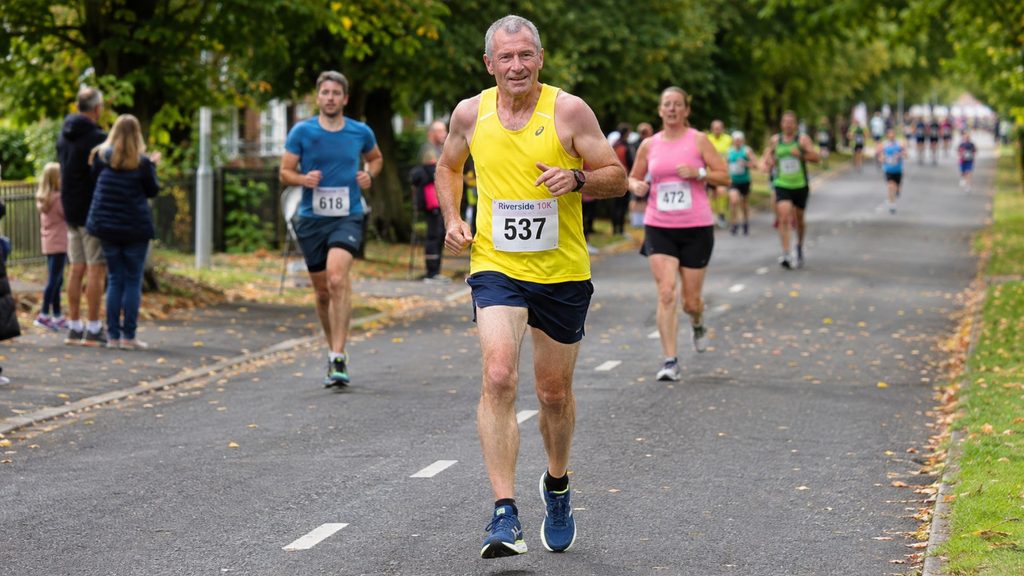
This is one of the questions we get most often as coaches, usually phrased as “how should I train for a 10km?” So this guide covers it all: how long your 10km training plan should be, what a training week looks like, how easy your easy runs need to be, the best sessions, how to adjust the plan when life gets in the way, goal paces, the taper and race day.
In this guide
How long should a 10km training plan be?
Typically, twelve weeks is the right length for most runners, as long as you can already run 5km. It gives your body time to adapt to the extra running, with room for a bad week, a cold or a work trip without your whole build-up falling apart.
Our 10km Training Roadmap is a 12-week plan, and that’s deliberate. The jump from 5km to 10km is very doable, but it’s still double the distance. Twelve weeks gives your muscles, tendons and ligaments time to adapt to the extra load, and that’s usually where runners who rush get caught out.
If you’re starting from scratch, start with 5km first. My colleague Lindsey’s guide on how to start running walks you through the first 12 weeks, from run-walk to running 30 minutes without stopping. Then the 10km build starts.
Can you train for a 10km in 8 weeks?
Yes, if you’re already running regularly. If you’ve been running three or four times a week and a 5km feels comfortable, eight weeks is enough to get you to the start line feeling ready. You’ll just have less margin for missed weeks, so consistency outweighs any temptation to cram in extra kilometres.
Can you train for a 10km in a month?
Only if you’re already fit. Four weeks isn’t really enough time for major adaptation. It’s enough time to sharpen what you already have and then taper. If you can already run 8 or 9km comfortably, a month of focused training will help you run a better race. If you’re coming from 5km, I’d suggest choosing a race further out, or entering this one to enjoy it rather than race it.
| Where you are now | Time to train for 10km |
|---|---|
| Can’t yet run 30 minutes without stopping | 12 weeks to 5km first, then 12 weeks to 10km |
| Running 5km comfortably | 12 weeks |
| Running 3-4 times a week, 5km feels easy | 8-12 weeks |
| Already running close to 10km | 4-8 weeks to sharpen up and taper |
Choosing a 10km training plan for your level
The right 10km training plan is the one that matches the runner you are today, not the time you’d like to run. The best way to find that is a recent race or time trial: a 5km time trial tells you far more than a target you’ve picked because it sounds good.
Here’s how I’d think about it at each level.
10km training plan for beginners
If this is your first 10km, your goal is simply to finish strong and enjoy it. You don’t need much speed work at all. Focus on running three or four times a week, keep almost every run easy, and let your long run steadily increase. If you’re coming from 5km, Lindsey’s rule of thumb is to add 2-3 minutes a week to your longest run, gradually cut down any walk breaks, and move from three to four runs a week when you’re ready.
Walk breaks are not cheating, by the way. If walking for a minute on a hill keeps you running consistently week in and week out, it’s doing its job.
Intermediate 10km training plan
If you’ve run a 10km before and want to go faster, this is where quality sessions come in. Keep your four days a week of running, but make one of them a proper higher-intensity session: intervals, a tempo run or hill repeats. Your easy runs and long run stay easy. The improvement comes from that one session being done properly, and from recovering well enough to do it properly again next week.
Training for a goal time
Once you have a time in mind, sub-60, sub-50 or faster, the plan’s framework stays the same. What changes is the pace of your sessions and how much quality work you do. There’s more on setting a realistic goal and pace further down.
What a 10km training week looks like
A good 10km training week is three runs of mixed intensity and duration plus a long run, with strength training on two or three days. Here’s the weekly structure we use at Coach Parry:
| Day | Session |
|---|---|
| Monday | Strength training |
| Tuesday | Higher-intensity session (intervals, tempo or hills) |
| Wednesday | Strength training |
| Thursday | Easy run plus strength training |
| Friday | Rest |
| Saturday | Long run |
| Sunday | Easy run |
Friday is a full rest day before the long run, and there’s only one set of back-to-back running days. That’s intentional. You want to arrive at your Tuesday session and your long run with fresh legs.
Can you train for a 10km running 3 days a week?
Yes. Keep the same strength days and run on Tuesday, Thursday and Saturday. That gives you a quality session, an easy run and a long run, which covers the basics well. When three runs a week feels comfortable, add the Sunday easy run as your fourth day.
How the 12 weeks fit together
The weeks are not all the same. In our marathon plans we build in four-week cycles: three weeks of loading, then a lighter week so your body can absorb the work, with a 5km time trial every four weeks to check the plan still fits. I’d use the same approach for a 10km. Here’s roughly how I’d lay out the 12 weeks:
| Weeks | Focus |
|---|---|
| 1-3 | Build consistency: easy running, long run steadily increasing, one short quality session |
| 4 | Lighter week and a 5km time trial to check progress |
| 5-7 | Longer quality sessions, long run keeps increasing |
| 8 | Lighter week and a 5km time trial to check progress |
| 9-10 | Most race-specific work: sessions at or close to 10km pace |
| 11-12 | Taper and race |
As a rule of thumb, don’t increase your total weekly running time or distance by more than about 10% from one week to the next. If a week feels too hard, repeat it. That’s not failing. That’s coaching yourself.
Why easy runs are more important than you realise
Easy runs build your aerobic engine, and for a 10km that engine does most of the work. Most of your weekly running should be at an easy, conversational effort, even when you’re training to race fast.
This is the part runners struggle with most. Easy needs to FEEL easy, not just comfortable. If you can’t hold a full conversation, you’re going too fast. And when easy runs creep up in pace, you end up tired for the big sessions, so the sessions that are supposed to make you faster never get done properly.
There’s good evidence for this from 10km-type racing specifically. In a 2007 study, 12 sub-elite runners trained for five months on one of two programmes. Both did the same small amount of hard training, but one group did about 80% of their training at low intensity and the other about 67%, with more time in the “moderately hard” middle zone. Both groups improved on a 10.4km cross-country race, but the group doing more easy running improved by about 157 seconds, compared with about 122 seconds for the other group (Esteve-Lanao and colleagues, 2007).
That’s the “kind of hard” zone most runners spend every run in. Spend less time there, and your hard sessions get better.
The difficulty is knowing what your easy pace actually is. It’s personal, and it’s not your running partner’s pace. If you’re not sure, use our free training zone calculator to work out your ideal training paces, so every run in your plan does the job it’s meant to.
How long should your long run be for a 10km?
Your long run should steadily increase through your plan, but for a 10km it doesn’t need to be huge. Its job is to build endurance so that the last 3km of your race doesn’t feel like you’re hanging on for dear life.
Run it at an easy, conversational pace. The race-pace work comes from your Tuesday session, not your long run. If you’re a slower runner, think in time rather than distance, because 10km takes some runners 50 minutes and others 75 or more. Build the time on your feet gradually, adding a few minutes a week, and ease back in your lighter weeks.
No single session or long run can define the success of a plan. If one long run goes badly because it was hot or you slept badly, move on. It’s what you do week in and week out that counts.
The best 10km training sessions
The best 10km sessions are intervals, tempo runs, hill repeats and strides. A 10km sits right between speed and endurance, so a good plan rotates through these rather than doing the same session every week.
Always warm up with at least 10 minutes of easy running before a quality session, and cool down with a few minutes of easy jogging afterwards. And do the session that’s right for where you are now, not just the one you saw an influencer doing.
| Session | What it does for your 10km | Example |
|---|---|---|
| Intervals | Builds speed and aerobic power | 6 x 3 minutes hard, 2 minutes easy jog between them |
| Tempo run | Teaches you to hold a strong pace for longer | 20 minutes at a comfortably hard pace |
| Hill repeats | Builds strength and power with less impact | 6 x 60 seconds uphill, jog back down |
| Strides | Improves form and leg speed | 4-6 x 20 seconds quick and relaxed after an easy run |
Intervals
Run each rep at a pace you could just about hold for the whole set, not flat out on the first one and hanging on for the rest. Your last rep should be as quick as your first. If it isn’t, you started too fast.
Tempo runs
Tempo running is especially useful for a 10km because it teaches you to hold a strong pace without falling apart in the second half. It should feel comfortably hard: you could say a few words, but you wouldn’t want to chat.
Hill repeats
Hills are speed work in disguise. Run up at a strong, controlled effort, drive your arms and stay tall, then jog or walk back down. In a week with one quality session, do hills or intervals, not both.
Strides
Strides are short, relaxed accelerations of about 20 seconds at the end of an easy run. They’re not sprints. They’re one of the easiest ways to bring a bit of speed into a beginner’s plan without adding much fatigue.
For a deeper dive into each session, my guide on how to run faster goes through them one by one.
Why strength training is crucial for a 10km
Strength training improves running economy by 2-8%, which means you use less energy at the same pace. Over 10km, that’s the difference between holding your pace in the last few kilometres and watching it slip. It also reduces your risk of injury, so you can train consistently.
Two or three sessions a week is the target, which is why strength sits on Monday, Wednesday and Thursday in the week above. You don’t need a gym. If you’re new to it, body weight is still resistance. Focus on squats, lunges, step-ups, hip hinges, calf raises and some core work.
A few guardrails:
- Get your technique right before you add weight.
- When an exercise gets easy, add weight or a heavier band, but DON’T keep adding reps and sets.
- Keep heavy sessions away from the day before your quality session.
- Strength work is there to complement your running. We’re training you to be a stronger, more efficient runner, not a bodybuilder.
How to set your 10km goal time and pace
Set your goal from a recent 5km, not from a time that sounds nice. A recent 5km race or time trial is the most honest measure of where your fitness is today, and your training paces should come from it.
Here’s a worked example. In his complete guide to marathon training, Lindsey uses a runner who can run a 27-minute 5km: that runner has the potential for roughly a 56-minute 10km. Notice it’s not 54 minutes, double the 5km time. You can’t hold your 5km pace for twice as long, so your 10km pace will be a little slower per kilometre than your 5km pace. Plan for that and you won’t go out too fast.
Once you have a realistic goal, here’s the average pace it needs:
| 10km goal time | Pace per km | Pace per mile |
|---|---|---|
| 70 minutes | 7:00 | 11:16 |
| 60 minutes | 6:00 | 9:39 |
| 55 minutes | 5:30 | 8:51 |
| 50 minutes | 5:00 | 8:03 |
| 45 minutes | 4:30 | 7:15 |
| 40 minutes | 4:00 | 6:26 |
Be realistic about the jump. Going from a 62-minute 10km to sub-60 in one 12-week block is achievable for most runners. Going from 62 minutes to 50 is a big jump, and probably needs more than one training cycle. For what it’s worth, my own 10km PB is 59:53, so I know exactly how hard that sub-60 barrier can feel.
Keep checking your goal as you go. A 5km time trial every four weeks works well for this, and if your times are coming down, adjust your paces with them. If they’re not, it’s usually a sign of too much medium-effort running or not enough recovery, not that you need to train harder.
How to adjust your 10km training when life gets in the way
The best plan is the one you can stick to, so learn how to adapt it rather than abandoning it. Here’s how I’d handle the most common problems.
- No hill nearby: do your hill session on a treadmill at about a 4% gradient.
- Hilly routes on easy days: hills can throw your pace all over the place. Run the effort, not the pace. As long as your easy runs feel easy, don’t overthink the numbers.
- Hot days: heat pushes your heart rate up and your pace down. Slow down and stick to the effort, or move your run to early morning.
- Tired legs or a bad night’s sleep: swap your hard session for an easy one. A missed session costs you very little. Forcing it when you’re exhausted can cost you a week.
- Travelling: keep the runs short and easy, and do a bodyweight strength session in your hotel room. Pick up the plan when you’re home.
- Missed a week through illness: don’t try to catch up. Go back a week in the plan and carry on from there.
One more trick that helps a lot of runners: turn off your watch’s pace alerts on easy runs. You’ll learn to run by feel, and you’ll probably enjoy your runs more.
If a niggle is getting worse, or pain is changing how you run, stop and see a physiotherapist. A few easy days now is better than weeks off later.
5km vs 10km training: what’s different?
10km training has more endurance in it than 5km training. The structure of the week is the same, but the long run matters more, and your quality sessions shift from short, sharp intervals towards longer intervals and tempo running.
| 5km training | 10km training | Half marathon training | |
|---|---|---|---|
| Main quality session | Short intervals | Longer intervals and tempo | Tempo and race-pace running |
| Role of the long run | Supports the speed work | Builds endurance for the second half | The key session of the week |
| Typical taper | Short | Up to two weeks | Two to three weeks |
Going the other way, from 10km to the half marathon, the long run becomes the centre of your week. Lindsey covers that in his half marathon training plan guide, and it’s a natural next step once your 10km is done.
How to taper for a 10km race
Taper for up to two weeks before your 10km by cutting how much you run, but not how often or how hard. Keep your usual running days and keep a little quality in your sessions, just less of it.
The research backs this approach. A meta-analysis of 27 studies in Medicine & Science in Sports & Exercise found the most effective taper lasted two weeks, reduced training volume by 41-60%, and kept training intensity and frequency the same (Bosquet and colleagues, 2007).
In practice, for a 10km:
- Two weeks out: shorten your long run and trim your easy runs. Keep your quality session, with fewer reps.
- Race week: run on your usual days, but keep the runs short and easy, with a few strides to keep your legs feeling sharp. Drop the strength training or make it very light.
- The day before: rest or a very short, easy jog.
You may feel a bit sluggish during the taper. That’s normal. Don’t use it as a reason to squeeze in one last hard session.
How to pace and fuel your 10km on race day
Start a little slower than your goal pace for the first kilometre or two, settle into goal pace through the middle, and only push from about 7 or 8km. Going out too fast costs you far more in the second half than it ever saves in the first.
The first kilometre is where most 10km races are lost. Adrenaline and a crowd make goal pace feel easy, so check your watch early and hold back. If the first few kilometres feel a bit too comfortable, that’s the plan working.
Do you need gels for a 10km?
Most runners don’t. A 2014 review in Sports Medicine concluded it isn’t necessary to take in large amounts of carbohydrate during exercise lasting about 30 minutes to an hour, and that even rinsing a carbohydrate drink around your mouth may be enough to give you a performance benefit (Jeukendrup, 2014). Eat a normal, familiar meal a few hours before the start, drink to thirst, and take water at the stations if it’s warm.
If your 10km is going to take you well over an hour and you like having a gel, take one you’ve already tried in training. Nothing new on race day: that goes for gels, shoes and breakfast.
How to warm up for a 10km
Jog easily for about 10 minutes, then do a few strides. The faster you plan to run, the more important the warm-up becomes, because you want to be ready to run goal pace from the first kilometre without a shock to the system. Running drills are a great addition here. Get our free running drills sequence, practise it at home in training, and use a few of the drills as part of your race-day warm-up.
10km training FAQs
Do you need to train for a 10km?
If you want to enjoy it and finish strong, yes. A regular runner can get round a 10km without a specific plan, but even a few weeks of structured training will make the race feel far better. If you’re newer to running, building up gradually also reduces your risk of injury.
How many days a week should I run for a 10km?
Four days a week of running works well for most runners: a quality session, two easy runs and a long run, with strength training alongside. Three days a week is enough for beginners or anyone short on time.
Can I train for a 10km in 2 weeks?
Not really. Two weeks isn’t long enough to build fitness, only to taper. If your race is two weeks away, keep your running easy and consistent, do a short session or two, rest well, and run the race at an effort you can hold.
Is it better to train by pace or heart rate for a 10km?
Start with effort. Use pace or heart rate as a check, not the boss. Wrist heart rate can be unreliable, and pace is thrown off by hills and heat. If you do train by heart rate, a chest strap gives you much better data.
How we can help you race your best 10km
The quickest way to a better 10km is a 10km training plan that gets the balance right for you: the right easy pace, the right sessions, the right amount of recovery and strength work, and a taper built in. That’s exactly what our 10km Training Roadmap does. It’s a 12-week plan with pacing guidelines for every run, strength training you can do at home, and everything from training through tapering to race day, whether you’re chasing a sub-40 10km or simply want to finish in one piece.
Not running 5km yet? Start with our 5km Training Roadmap and come back to this one in 12 weeks.
Either way, the next step is the same: pick your race, count back 12 weeks, and do your first easy run this week. Hope that helps, and good luck with your build.
More guides on 10km training
- How to run faster: a coach’s guide to your quickest times
- How to start running: everything you need to know
- Half marathon training plan: a coach’s guide
- How I ran a 5km PB using only easy, heart-rate-based training
- How Lisa took her 10km time from 1:07 down to 52 minutes
- How Dave Baer ran a sub-55 10km
- How Simoni shaved 6 minutes off her 10km PB


Comments are closed.